
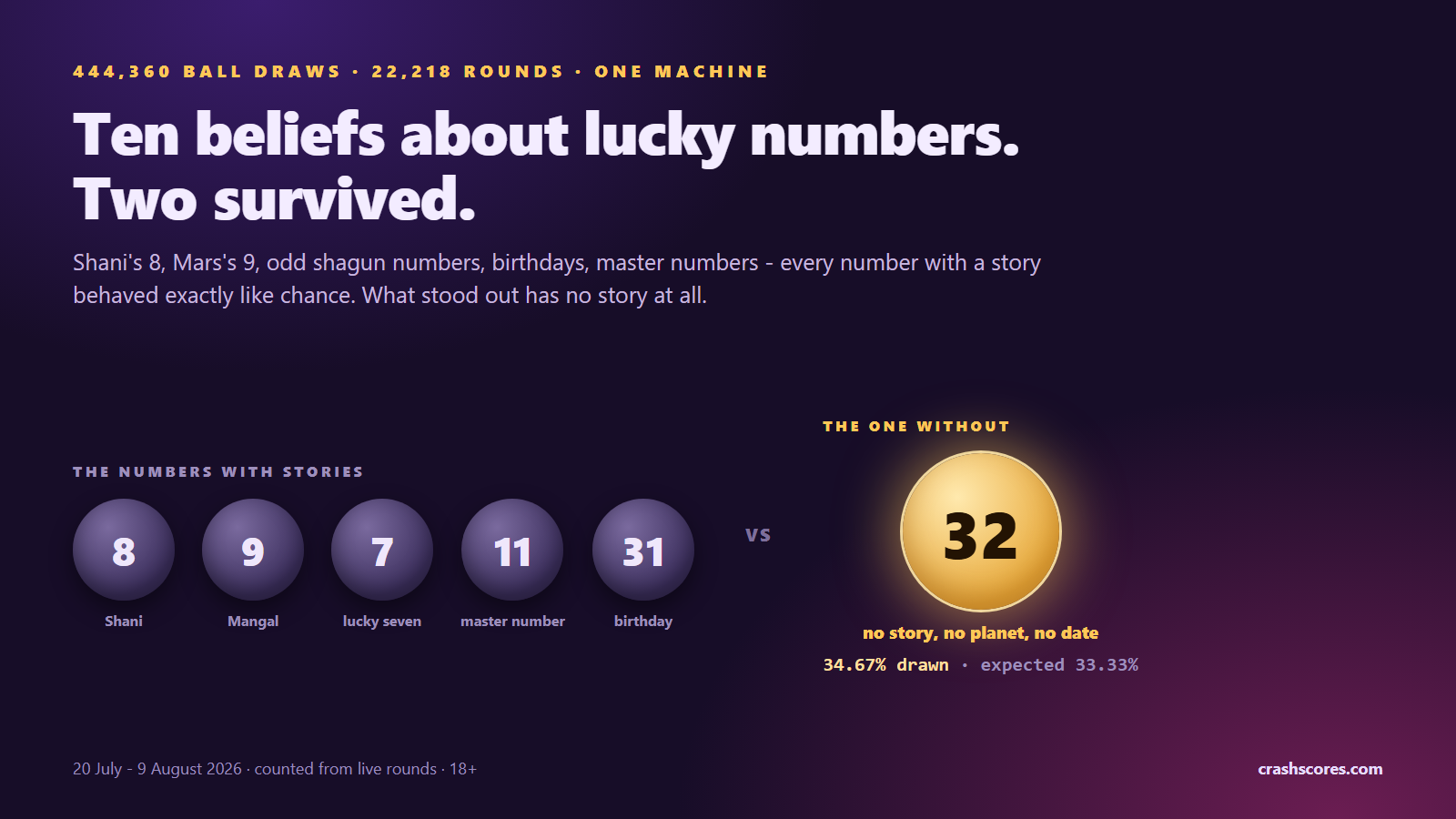
Almost everyone has a number. A birth date, a house number, the one that seems to follow you around. And almost nobody can check whether it actually turns up more often, because nobody is counting.
For three weeks, somebody did.
MONOPOLY Big Baller is a live game show streamed from a studio. A presenter runs a device holding 60 numbered balls, and 20 of them are drawn each round, one by one. A fresh draw starts roughly every minute and a bit, and it never stops. That gives every number the same flat theoretical expectation: twenty out of sixty means each ball should turn up in one round in three – 33.33%.
Between 20 July and 9 August 2026, 22,218 rounds were tracked – the complete results history is public. That is 444,360 individual ball draws, which is enough to test the things people usually believe.
We collected nine beliefs which are pretty popular in India, and added a tenth that nobody believes at all. Here is how each one did.
Every chart ends in a verdict, and the verdicts mean something exact.
True means a belief looks reasonable.
Barely true means a belief has a small confirmation which actually does not mean anything specific.
False means a belief is not confirmed at all.
1. “Certain digits carry luck, or trouble”
Here the number people step around is 8. It belongs to Shani, and Saturn’s reputation for delay, hardship and slow karmic accounting has made 8 the digit families quietly avoid when picking a house, a car plate or a wedding date. Nine, ruled by Mangal, sits at the other end – the number of force and drive rather than delay.
If a digit carried anything, every number ending in it should carry a little too.
Grouping all 60 balls by their last digit gives a range of 33.04% to 33.52%. Numbers ending in 8 did not lag at all – they finished above the line, at 33.39%. The belief points the wrong way. Numbers ending in 9 did not meaningfully lead either, and no digit separated itself from the rest.
False.
2. “Small numbers come up more”
A common instinct, probably because small numbers are simply more present in daily life.
Balls 1-30 averaged 33.39%. Balls 31-60 averaged 33.28%. A very small lead for the smaller numbers.
Barely true.
3. “Odd numbers are luckier”
Deeply rooted here. Gift amounts are given as ?101, ?501, ?1,001 – never the round even figure.
The thirty odd balls averaged 33.39%. The thirty even ones, 33.27%.
Odd numbers are leading with a very brief extra luck.
Barely true.
4. “Primes are special”
Indivisible, unpredictable, and attractive to anyone who likes numbers having character.
There are seventeen primes below 60 – 2, 3, 5, 7, 11 and so on up to 59. Together they averaged 33.29%, against an expected 33.33%.
False.
5. “Multiples of seven carry the luck of seven”
Seven, fourteen, twenty-one, and so on up to fifty-six. Eight balls in all.
They averaged 33.36% – three hundredths of a point above the line. A very small difference, but it exists.
Barely true.
6. “Play your birthday”
The best-documented number habit there is. Lottery picks worldwide cluster hard in the 1-31 range because that is where dates live.
Balls 1-31 averaged 33.41%. Balls 32-60, the range no birthday can reach, averaged 33.26%. Pretty similar to the result in test #2.
Barely true.
7. “Repeating digits are powerful”
Eleven, twenty-two, thirty-three. Numerology calls these master numbers, and the wider idea of angel numbers extends the same thinking to any doubled digit.
Those five balls – 11, 22, 33, 44, 55 – averaged 33.00% – the lowest of the everyday-belief groups. Only Venus’s planet group in test 9 went lower.
False.
8. “Some balls come out early”
Less mystical, more mechanical: the idea that certain balls surface first, so the opening draws tell you something.
Average draw position across all sixty balls runs from 10.36 to 10.71 out of 20, against a midpoint of 10.5.
False.
9. “Your number belongs to a planet”
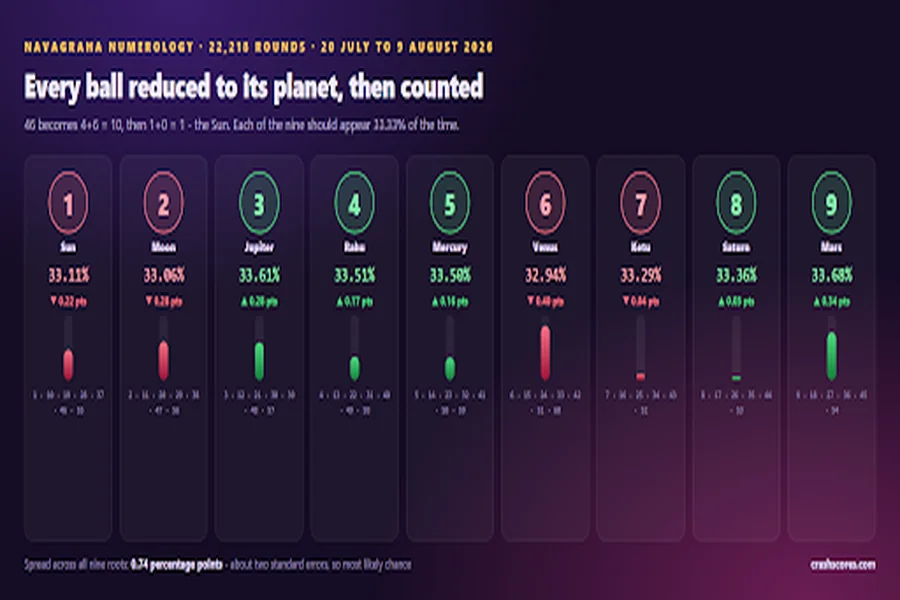
This is not loose superstition but the system itself. In Indian numerology every number reduces to one of nine, and each of those nine belongs to a graha: 1 Sun, 2 Moon, 3 Jupiter, 4 Rahu, 5 Mercury, 6 Venus, 7 Ketu, 8 Saturn, 9 Mars. You reduce by adding digits until one remains – 46 becomes 4+6 = 10, then 1+0 = 1, and so falls to the Sun.
It is taken seriously enough here that people adjust the spelling of their own names to land on a friendlier number.
All 60 balls sort into those nine. Mars came out highest at 33.68%. Venus lowest at 32.94%. Saturn – the number carrying all the dread – finished at 33.36%, three hundredths of a point above where it was supposed to be. Eight of the nine sit inside the band. Only Venus steps out of it. Every ball reduced to its planet. Saturn and Ketu landed within a few hundredths of expected.
True.
10. “One number is luckier than another”
Nobody holds this one. There is no story attached to 32 – no planet, no digit, no date, nothing to adjust the spelling of your name for. Which is exactly why it belongs last: individual balls are not equal.
Drawn most: 32 (34.67%), then 54 (34.33%), 20 (34.30%), 9 (34.27%), and 25 and 31 tied (34.03% each).
Drawn least: 46 (31.96%), then 11 (32.35%), 38 (32.55%), 47 (32.60%), 44 (32.61%).
Ball 32 came up 600 more times than ball 46 across the same date period.
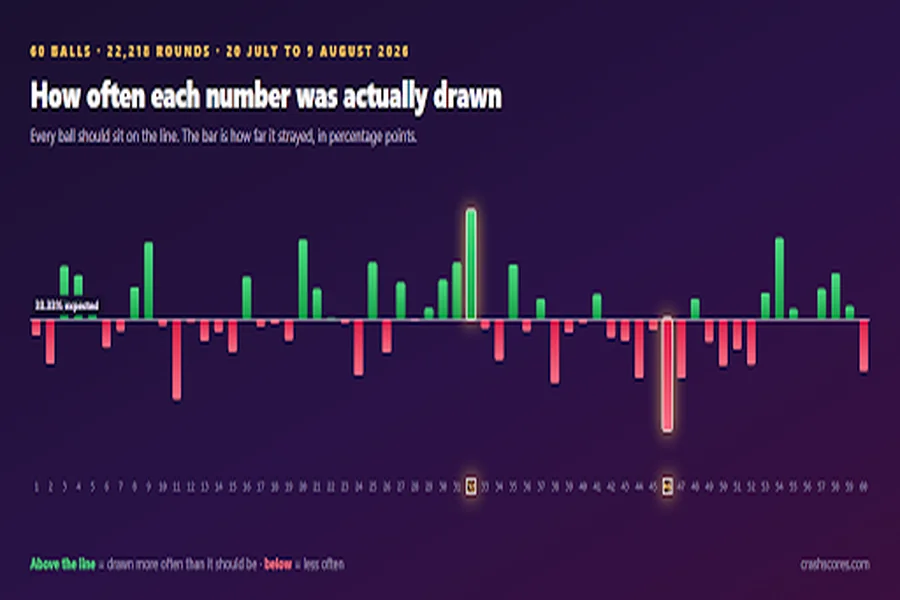
Green bars were drawn more often than expected, red less. 25 balls finished above the line, 34 below – and one, ball 56, landed exactly on it: 7,406 appearances in 22,218 rounds, one in three to the round.
True.
All ten beliefs in one picture
How to read it: the gold line is the 33.33% every ball is owed; the grey band is the range luck alone produces for a group of that size. A dot inside the band cannot be told apart from chance – only dots that step outside it mean anything.
Two things before anyone gets ideas
This is a physical machine, not a computer. Sixty real balls, tumbled thousands of times a day, differ slightly in weight, paint and wear.
Everybody sees what they want to see. Every number people have built a belief around – Saturn’s 8, Mars’s 9, the odd-numbered shagun, birthdays, master numbers – has some historical or cultural background behind it. Someone believes number 4 is evil; in a different culture they may think the opposite.
Figures from round-by-round game show records kept by CrashScores, covering 22,218 complete rounds between 20 July and 9 August 2026. These games are for adults only.
