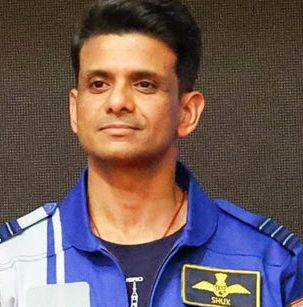
Shubhanshu Shukla, an Indian Air Force officer, has made history by becoming the second Indian in space. He successfully launched into space aboard the SpaceX Falcon-9 rocket on June 25, 2025, as part of the Axiom-4 mission. Shukla sent his first message, proudly mentioning the tricolor on his shoulders. In this article we bring you everything that you want to know about Shubhanshu Shukla. Lets know more about Shubhansu Shukla Age, Height, Bio, Wiki, Affairs, Facts & More
Shubhanshu Shukla Age, Height, Bio, Wiki, Affairs, Facts & More
Shubhanshu Shukla is an Indian Air Force officer and astronaut set to make history as the second Indian in space. Born on October 10, 1985, in Lucknow, Uttar Pradesh, Shukla has come a long way from being a fighter pilot to becoming a key figure in India’s space application.
Shukla served as a fighter pilot, flying advanced aircraft such as the Su-30 MKI, MiG-21, MiG-29, and Jaguar.
He was selected as one of the four astronauts for India’s first human spaceflight program, Gaganyaan.
Also, Shukla is set to pilot the SpaceX Dragon spacecraft to the International Space Station (ISS) as part of the Axiom-4 mission, a collaborative effort between Axiom Space and NASA.
The mission launched on June 25, 2025, from NASA’s Kennedy Space Center in Florida. Shukla is joined by Commander Peggy Whitson and specialists from Hungary and Poland.
The crew will conduct food and nutrition experiments on the ISS, and Shukla’s experience will contribute to India’s Gaganyaan mission.
Shubhanshu Shukla is married to Kamna Shubha Shukla & they have a son whose name is Kiyas who born in 2020.
His net worth is estimated to be around 4 crore rupees.
Education and Background
School: City Montessori School, Aliganj, Lucknow
Educational Qualification: Passed 12th standard in 2001
Shukla is set to become the second Indian astronaut in space after Rakesh Sharma, who flew aboard Soyuz T-11 in 1984.
The Axiom-4 mission marks a significant milestone for India’s space program, demonstrating the country’s growing capabilities in human spaceflight.