
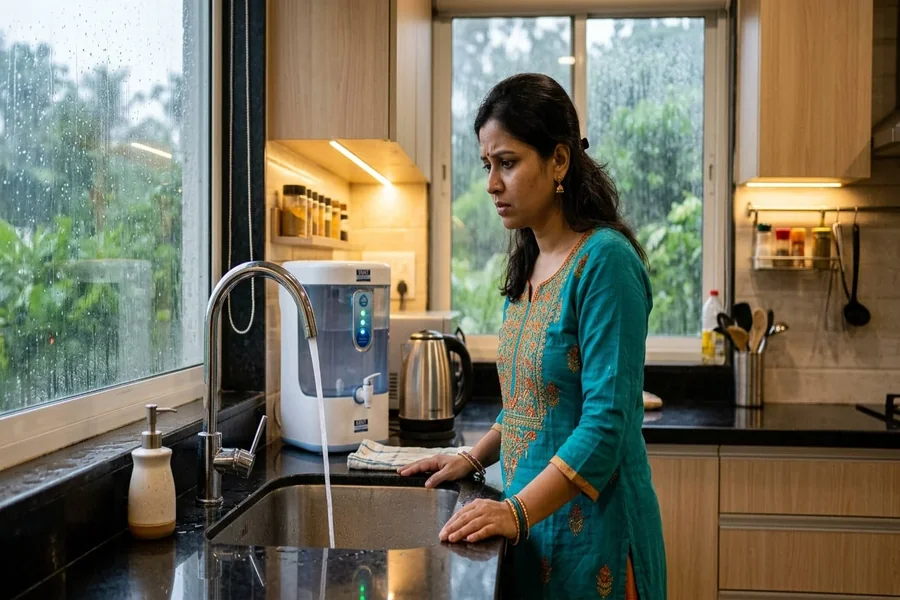
Nobody thinks about their water filter. Seriously. It’s one of those things that just sits in your kitchen, quietly doing its job, and you forget it exists until something goes wrong.
I get it. I was the same way.
Then one monsoon, my daughter complained her water tasted “weird.” My wife noticed the flow had slowed down. And within a week, half the house had stomach trouble. Turned out our water purifier for home the one we’d trusted for two years simply wasn’t built to handle what monsoon throws at it.
That experience changed how I think about water filtration entirely. And if you’re reading this right before or during rainy season, it might save you a similar headache.
Understanding Monsoon Water Quality: Why Your Regular Supply Isn’t Safe Enough.
Here’s something most people don’t fully grasp. The water reaching your tap in March and the water reaching your tap in August? Practically two different liquids.
Rain itself is clean enough. The trouble begins the second it touches the ground. All that runoff tears through farmland soaked in pesticides, sweeps past open sewage drains, picks up heavy metals from construction sites, and eventually dumps into the same reservoirs and borewells feeding your municipal supply.
Now, your city’s water treatment plant wasn’t exactly sitting idle before the monsoon either. It was already running at near capacity. Suddenly the raw water coming in is three, sometimes four times dirtier than usual. The plant does what it can. But “what it can” and “what you need” aren’t the same thing during those months.
The Central Pollution Control Board and this isn’t some random claim, you can look it up has documented 30 to 40 percent spikes in coliform bacteria across Indian urban water supplies during peak monsoon. TDS levels go haywire. One reading says 190. Two weeks later, same tap, same house, 520. That kind of swing is exactly why picking the right water purifier for home use matters more than most people realize, because it breaks the assumptions your filter was designed around.
The Limitations of Common Water Purifiers When Monsoon Water Quality Drops
Gravity-Based Purifiers
- Carbon filters handle chlorine and basic sediment well enough during normal months.
- No membrane means nothing stops dissolved pesticides or the bacterial surge monsoon water carries.
- Essentially running contaminated water through a basic filter and hoping for the best.
UV Purifiers
- UV light kills bacteria and viruses effectively under normal conditions.
- However, UV only works well on clear water monsoon increases turbidity significantly.
- Suspended particles create hiding spots for bacteria that UV light simply cannot reach.
- The green indicator keeps glowing, but contaminants are still getting through.
RO Systems
- Genuinely solid technology, but monsoon puts them under serious stress.
- Pre-filters clog faster due to the sharp rise in sediment levels.
- The RO membrane works overtime, wears down quicker, and starts letting through impurities it would have blocked easily in drier months.
- If filters haven’t been changed recently, the drop in performance is real and silent. You won’t taste it until it’s already a problem.
Essential Features To Look For In A Monsoon-Ready Water Purifier
Alright, enough about what doesn’t work. Let’s talk about what does.
A water purifier for home that can genuinely handle monsoon needs layers. Not one magic filter. Layers. Sediment pre-filtration first, catching the big stuff before it clogs anything downstream. Then RO or a combined RO plus UV stage to deal with dissolved chemicals and the biological threats that slip past everything else.
But the thing that really separates a good monsoon purifier from an average one? Adaptability.
Your source water TDS might sit at 180 one week and jump to 550 the next. A purifier running at one fixed setting treats both situations identically. That’s like wearing the same jacket in December and June technically it’s a jacket, but it’s wrong for at least one of those months.
Newer systems with real-time TDS monitoring actually read what’s coming through your pipes and adjust filtration accordingly. First time I heard about this I thought it was marketing fluff. It’s not. When your input water quality changes that dramatically across a season, adaptive purification genuinely keeps your output consistent. Static systems just can’t match that.
If you’re in the market right now, a water purifier for home with smart TDS management and multi-stage filtration deserves a serious look. Especially if your area’s water goes south every July like clockwork.
The Cost Of Skipping Timely Water Purifier Maintenance Before Monsoon
Okay, this is the part where I get a little preachy. Forgive me.
People buy a good purifier. Spend decent money on it. And then completely ignore servicing until something breaks or someone gets sick. During monsoon, this habit goes from careless to genuinely risky.
Picture this. Your sediment filter was last replaced in, say, January. Five months of regular use later, it’s already partially saturated. Monsoon arrives in June and the sediment load in your water triples almost overnight. You’re asking a half-exhausted filter to do the hardest work of its entire lifespan. How do you think that ends?
RO membranes rated for 12 months? Under brutal monsoon water conditions, you might realistically get 8 months. Sometimes less depending on where you live.
The fix is embarrassingly simple. Call your service guy in May. Get everything swapped out before the rains. Not during. Not after someone falls sick. Before. That single decision saves you more grief than any upgrade ever could.
How To Identify Early Signs Of Water Purifier Failure During Monsoon
You don’t need a laboratory. Just use your senses and a little common sense.
Water suddenly tastes earthy? Metallic? That’s new contamination your filter isn’t catching. Flow rate dropped noticeably? Clogged filters restrict water flow it’s the first physical sign of overload. Your electronic purifier running purification cycles way more frequently than it did last month? That’s the machine working harder because input quality tanked.
And the big one. Stomach problems in your family that show up around July, hang around through September, and mysteriously vanish once monsoon ends? That’s not a coincidence. That’s your water purifier for home failing silently while telling you everything’s fine.
If any of that sounds familiar, please get your water tested. A basic test costs almost nothing and the peace of mind or the wake-up call is worth every rupee.
Conclusion
Monsoon water contamination isn’t theoretical. It isn’t rare. It happens every single year in every part of the country, and it catches families off guard because the one device they’re counting on was never stress-tested for these conditions.
Your water purifier for home handles fair-weather water beautifully. Nobody’s disputing that. But the gap between fair-weather capability and monsoon-season demand? That gap is where the stomach bugs live. That’s where the heavy metals sneak through. That’s where “we thought our water was clean” turns into a doctor’s visit.
Getting ahead of it doesn’t take much. A timely service call. Maybe an upgrade to something that adapts. Just matching your home’s purification to the reality of what’s actually flowing through your pipes.
That’s not paranoia. That’s just being smart about something you literally drink every day.
