
Introduction
In the realm of precision manufacturing, sourcing 5-axis CNC machining services for complex components often leads companies into a trap of competing solely on the lowest bid. This narrow focus frequently results in project delays, inconsistent quality, and exorbitant communication costs, causing the Total Cost of Ownership (TCO) to skyrocket beyond budget and even leading to missed market opportunities. The root cause lies in procurement decisions that are overly fixated on unit price, while overlooking a supplier’s engineering support capabilities, quality systems, process expertise, and overall management of complex projects. Traditional comparison models fail to evaluate these hidden costs and risks.
This article adopts a TCO perspective to present a six-dimensional evaluation framework, offering a deep dive into how to identify a 5-axis CNC machining partner capable of creating genuine value. By combining industry insights with cost analysis, it provides a guide for making strategic, informed choices. To make a wise decision, one must first understand the true cost of a poor selection.
Why is Comparing Only 5-Axis CNC Machining Price a Dangerous Decision?
Selecting a supplier based solely on the initial 5 axis CNC machining price is akin to planting a financial landmine. The true metric for evaluation should be the Total Cost of Ownership, encompassing all direct, indirect, visible, and hidden expenses. The allure of a low-cost vendor often masks three significant hidden costs: the high scrap and rework costs from unstable processes or lax quality control, which consume materials and labor; the expensive delays from repeated engineering changes due to poor communication; and the production line stoppages or missed market windows caused by unreliable delivery.
Research, such as that referenced by the American Society for Quality, indicates that in quality costs, “prevention costs” are far lower than “failure costs.” Sacrificing essential upfront engineering review and quality investment for a lower price can result in paying a multiple of the initial savings. Therefore, strategic decisions must be grounded in long-term value and risk management, not an isolated quote. The real expense of 5 axis CNC machining is not in the invoice, but in the sum of all costs incurred to receive a perfect, on-schedule part.
Which Six Core Dimensions Should Be Prioritized When Evaluating a 5-Axis CNC Service Provider?
For demanding custom 5-axis CNC machining manufacturing projects, a systematic evaluation framework is essential. Decision-makers should scrutinize potential partners across six core dimensions to ensure the success of their 5-axis CNC machining parts.
Technical Depth and Process Expertise
A true expert in Precision CNC Machining understands not just how to run machines, but the underlying process science. A critical distinction is whether a supplier’s “5-axis” capability refers to 3+2 positional machining or true 5-axis simultaneous machining, as this determines the complexity of part geometries they can handle effectively. A superior supplier acts as a consultant, recommending the most economical and efficient technical path for a given design.
Quality Systems and Engineering Collaboration
The synergy between a robust quality framework and proactive engineering is where value is created.
- Certifications as a Foundation for Rigor
While ISO 9001 is a baseline, certifications like IATF 16949 (automotive) and AS9100D (aerospace) represent the stringent process control and traceability demanded by high-stakes industries, systematically mitigating quality risk.
- Engineering Support as the Value Engine
Deep Design for Manufacturability (DFM) capability is paramount. An engineering team that proactively suggests design optimizations for better manufacturability, lower cost, and assured quality delivers value far beyond simple contract machining.
Transparency, Delivery, and Intellectual Property Protection
Reliable communication mechanisms and project transparency are the lubricants for smooth collaboration. Equally important is a supplier’s capacity planning and historical on-time delivery record, which signals commitment reliability. Finally, rigorous intellectual property protection measures form the bedrock of mutual trust.To delve deeper into a total-cost strategy for selecting a service provider, readers can explore this in-depth analysis on how to choose a cost-effective 5-axis CNC service provider.
How to Choose Between 3+2 Positioning and 5-Axis Simultaneous Machining for Optimal Cost Control?
Understanding the two primary operational modes of a 5 axis CNC machine is key to optimizing the final 5 axis CNC machining price. 3+2 positional machining involves tilting the cutting tool to a fixed angle and then performing 3-axis milling. It is ideal for multi-faceted parts, allowing multiple sides to be finished in a single setup, reducing operations, offering excellent tool rigidity, and representing a highly cost-effective choice.
In contrast, 5-axis simultaneous machining is necessary for parts with continuous, complex contoured surfaces like impellers, turbines, or aerodynamic housings. The tool can continuously adjust its orientation during movement, enabling single-setup finishing that guarantees superior accuracy and surface finish, but it demands significantly higher programming skill and machine dynamic performance.
Consider a hypothetical aluminum housing with deep cavities and free-form surfaces. Using 3+2 machining might require multiple re-fixturing, custom jigs, and result in poor surface quality needing expensive manual polishing. Employing 5-axis simultaneous machining with specialized toolpaths could achieve efficient, high-quality finishing in one go. The key is a precise analysis of the part’s geometric features, selecting the most economical and efficient process that meets technical requirements—a principle of technical-economic suitability emphasized by resources like TWI.
4: Are Online 5-Axis CNC Machining Platforms or Traditional Factory Models Better for Your Project?
Today, obtaining quotes from online 5-axis CNC machining services is effortless, but which model is superior for your Industrial Parts Fabrication project?
Evaluating Two Sourcing Models
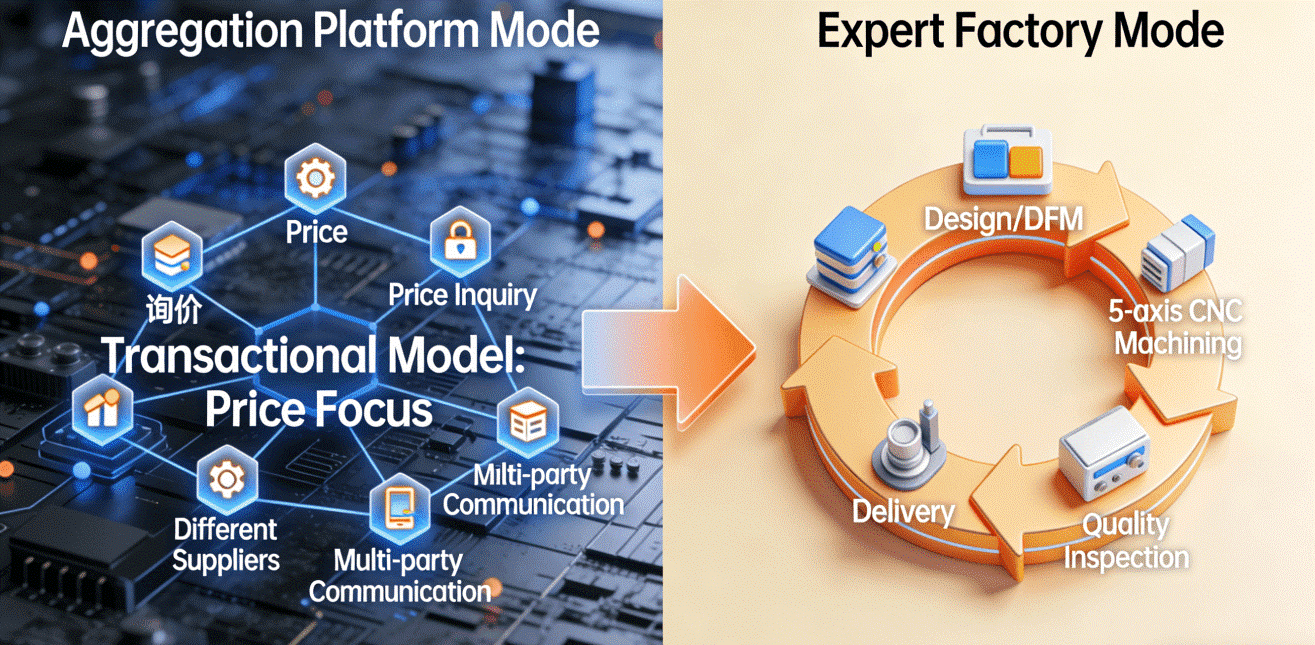
Selecting a service model is crucial. The choice between an aggregator platform and a dedicated expert factory fundamentally shapes project flow, communication, and outcomes.
- The Aggregator Platform Approach
This model excels in rapid online 5-axis CNC machining services comparison for standard components. Its strength is breadth of choice and streamlined quoting for simpler Industrial Parts Fabrication.
- The Expert Factory Model
For complex, high-precision parts, a direct partnership with a specialized provider is superior. Collaboration with an in-house engineering team enables seamless coordination from design to delivery, ensuring control and quality.
The Strategic Advantage of Integrated Expertise
The expert factory transforms a transaction into a partnership. This integration, where engineering and production are unified, enables proactive DFM, strict process control, and real-time technical support. The result is optimized manufacturability, mitigated risk, and a demonstrably lower total cost for sophisticated projects, delivering true long-term value.
How is Value Realized in High-End 5-Axis CNC Machining? A Medical Component Case Study
A European medical device company required a batch of custom, thin-walled, high-precision surgical instrument housings made from 316L stainless steel. An initial supplier offered an attractive 5 axis CNC machining factory, but the outcome was problematic: a first-pass yield of only 70% and consistently delayed deliveries.
The project was switched to a high-end supplier. Their team first conducted an in-depth DFM analysis, recommending a slight thickening of non-critical ribs by 0.15mm to greatly enhance machining stability. For production, they employed optimized 5-axis simultaneous helical toolpaths combined with custom vacuum fixtures to perfectly control cutting forces and vibration. They implemented first-article full-coordinate CMM inspection and Statistical Process Control (SPC) during production.
The results were transformative: the first-pass yield soared to 99%, and the total project cost (factoring in scrap, rework, management, and delay costs) was reduced by 35% compared to the initial approach. This real-world example of custom 5-axis CNC machining manufacturing vividly demonstrates how paying a higher unit price for 5-axis CNC machining parts can be directly converted into significant total cost savings, reduced risk, and reliable delivery through advanced engineering collaboration, sophisticated process application, and strict quality control.
Conclusion
Selecting a 5-axis CNC machining partner is a strategic decision concerning value, trust, and precision. The most cost-effective answer often lies not in the quotation, but in the supplier’s engineering intelligence, the robustness of its quality system, and its collaborative problem-solving capability. Moving beyond simple price comparison to a six-dimensional evaluation from a Total Cost of Ownership perspective is key to ensuring project success and gaining a long-term competitive advantage.
If you are facing manufacturing challenges with complex components and seeking a partner that can genuinely reduce total cost and accelerate time-to-market, it is time to start a professional conversation. Upload your part drawings to receive a detailed quote including free DFM analysis and TCO optimization advice.
Author Biography
The author is a precision manufacturing solutions expert with over 15 years of experience, specializing in advanced CNC machining technology and supply chain optimization. [He/She] is currently affiliated with JS Precision, a leading provider of customized manufacturing services.
FAQs
Q: What is the typical Minimum Order Quantity (MOQ) for 5-axis CNC machining?
A: Many professional service providers support R&D by offering services with no MOQ, accepting both single prototypes and batch production. Specific policies should be confirmed with the target supplier.
Q: What files are needed to get an online 5-axis CNC quote?
A: It is recommended to provide 3D models (STEP/IGES), 2D drawings, and clearly specify material, quantity, surface finish, and tolerance requirements. More detailed information leads to a more accurate quote and may include process optimization suggestions.
Q: How is the confidentiality of my design files ensured during the quoting process?
A: Reputable suppliers prioritize signing a Non-Disclosure Agreement (NDA) and use encrypted file transfer systems. Verifying that they have a clear information security policy is essential basic due diligence before cooperation.
Q: If a design change is needed mid-project, does the process become complicated?
A: Efficient suppliers assign a dedicated project manager. For changes, providing new drawings allows their engineering team to quickly assess the impact, update quotes and lead times, ensuring smooth project continuity.
Q: Besides ISO 9001, what other important certifications exist in high-end manufacturing?
A: IATF 16949 (automotive) and AS9100D (aerospace) are industry gold standards. ISO 13485 (medical devices) and ISO 14001 (environmental) also address specific sector and sustainability requirements, respectively.
