
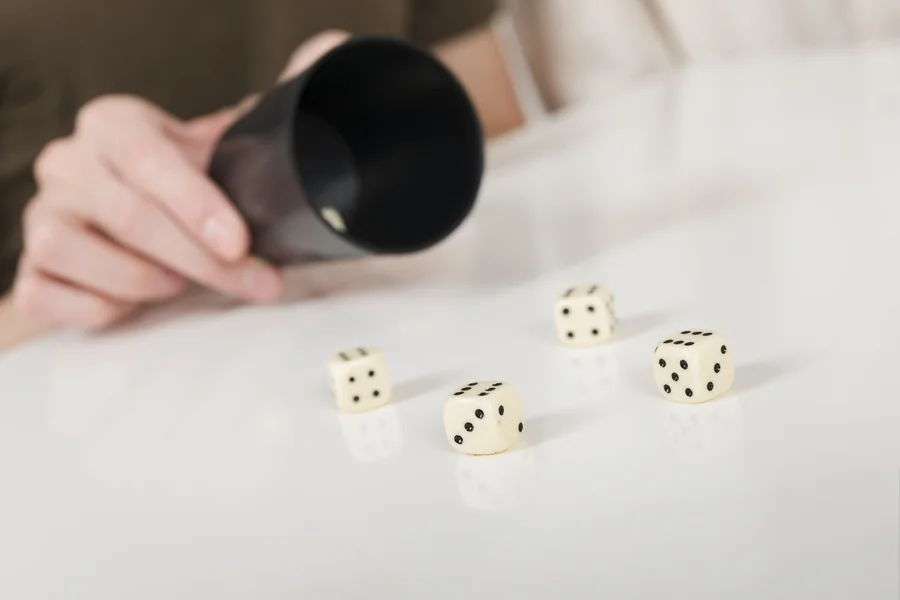
My grandmother kept a set of dice in a kitchen drawer, between the spare batteries and a small rubber band ball that had been growing since 1987. They were nothing special – standard plastic, slightly yellowed at the edges, the kind that came free with a board game that had long since lost half its pieces. But on certain evenings, when the television was boring and there was nothing particular to do, she’d pull them out and we’d play a game I never fully learned the rules of. It didn’t matter much. The rolling mattered. The waiting for the dice to settle mattered. The small ceremony of picking them up and throwing them again mattered.
I thought about those dice recently while reading about the growth of hosted dice formats in online entertainment. There’s a genre now – streamed, real-time, with a live host and visible throws on camera – that is pulling in audiences who have probably never held a physical die in their adult lives. The people writing about it tend to reach for technology to explain it: better streaming, lower latency, broader mobile access. These aren’t wrong. But they’re describing how the format travels, not why it lands. It shows up across different markets and age groups, in forums and review threads and casual conversations about what’s worth spending an evening on: ask someone who plays regularly why a well-produced live dice game draws them back session after session while a purely digital RNG format doesn’t, and they’ll usually arrive at the same answer – watching a physical object move through space feels categorically different from watching a number appear on a screen, and that difference matters more than expected.
What makes a throw feel real
There’s a word statisticians use that doesn’t get used enough outside statistics: legibility. It means the degree to which a process is visible and interpretable to an observer. A well-designed random number generator is more statistically random than any physical die. But it has zero legibility. The number appears and you accept it on trust – trust in the software, the platform, the audit report you’ve probably never read.
A physical die thrown on camera has complete legibility. You observe it exit the hand, you notice the path, you view the rebound, you see the rest. Every step in the process is observable and understood, even by someone who knows nothing about physics. This doesn’t make the outcome more random. It makes the outcome more real, in the experiential sense – something that happened in the world rather than something produced by a process you can’t see.
Five thousand years of the same game
People have been playing dice games since before writing systems existed. Excavations across Egypt, Mesopotamia, India and China have all turned up versions of the same object: six-sided, marked, designed to be thrown and read. The specific rules varied enormously. The object and the social ritual around it remained almost identical.
| Region | Approximate era | Local dice name | Playing context |
| Ancient Egypt | 3000 BCE | Astragali (knucklebones) | Ritual and leisure |
| Mesopotamia | 2600 BCE | Cubic dice (excavated at Ur) | Board games, wagering |
| Ancient India | 1500 BCE | Aksha | Ceremonial, social |
| Ancient China | 600 BCE | Zh?i tóu | Court games, military |
| Roman Empire | 1st century CE | Tesserae | Taverns, military camps |
| Modern digital | 2010s–present | Live hosted formats | Streamed, global |
The last row is not a break from the tradition in the table above. It’s a continuation. The format updated; the object and the ritual didn’t. Someone still throws something. Everyone still watches. The result still arrives simultaneously for all observers. The five-thousand-year design has turned out to be extremely portable.
Why this particular format is growing now
There’s a concept in entertainment design called parasocial presence – the sense of being with someone even when you’re watching them through a screen. It’s why people watch streamers play games they could play themselves. The streamer’s presence makes the experience social in a way that playing alone doesn’t. Hosted dice formats apply this logic directly. The host isn’t incidental to the experience. The host is part of why the throw feels like an event rather than a transaction.
This is worth sitting with for a moment, because it’s genuinely counterintuitive from a pure efficiency standpoint. If you wanted to design the fastest, most streamlined dice experience, you’d remove the human presenter. You’d reduce it to throw, number, result. What the growing audience for hosted formats is saying, implicitly, is that they don’t want the most efficient version. They want the version that feels like something is actually happening. My grandmother’s dice game had no official rules that I can remember. There was a throw, a result, and a response to the result. There was someone else in the room. That was the game. It turns out that this is a remarkably complete description of an entertainment format that people are choosing in 2025, on phones and tablets and laptops, in cities where a kitchen drawer full of spare batteries probably seems like a quaint idea. The dice knows things about what we want from an experience that the algorithms are still working out.

I am glad for commenting to let you be aware of what a nice discovery my wife’s daughter experienced going through your web page. She picked up plenty of pieces, not to mention what it’s like to have a great helping mood to get others easily learn about some very confusing matters. You truly exceeded visitors’ expected results. Thanks for rendering those invaluable, trusted, educational not to mention cool thoughts on the topic to Lizeth.