
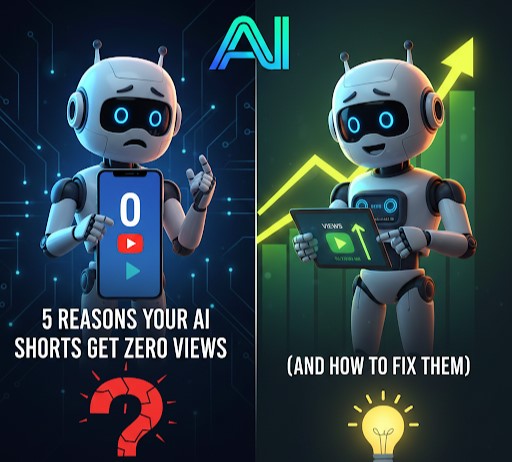
AI tools have made it incredibly easy to create short-form videos. Text-to-video generators, automated editing tools, and even advanced platforms that function as an ai clip maker now allow creators to publish Shorts, Reels, and TikToks in minutes. Yet despite this convenience, many creators face the same frustrating result: zero views—or content that never moves beyond a handful of impressions.
After analyzing hundreds of AI-generated Shorts across YouTube, TikTok, and Instagram, a consistent pattern emerges. The problem is rarely the tool itself. Instead, it’s how the content is structured, positioned, and perceived by both viewers and algorithms.
This article breaks down the five most common reasons AI Shorts fail to get views—and, more importantly, how creators are fixing them in practice.
Weak Hooks That Don’t Stop the Scroll
Short-form platforms are built around interruption. A video either stops the scroll immediately or disappears into the feed. One of the most common issues with AI Shorts is a weak opening—often caused by generic visuals, slow intros, or delayed context.
In many cases, AI-generated videos start the way long-form videos do: a calm introduction, a logo animation, or a setup that assumes patience. Shorts audiences don’t offer that luxury. Platforms measure early engagement in seconds, not minutes.
A small educational Shorts channel tested two versions of the same AI-generated explainer. The first version began with a title-style intro (“Did you know AI can do this?”). The second version opened with a bold outcome (“This AI video got 10× more reach after one change”). The second version retained viewers nearly twice as long in the first three seconds and was pushed further by the algorithm.
What works instead is leading with the result, tension, or visual payoff immediately. Successful AI Shorts often show the end first, then explain—or hint at—the process. This isn’t clickbait when the content actually delivers; it’s clarity.
Shorts That Look Obviously AI-Generated
Viewers are becoming surprisingly good at detecting AI patterns. Repetitive stock footage, overly smooth transitions, robotic pacing, and generic captions create a sense of artificiality that lowers trust—even if the information itself is useful.
Platforms don’t explicitly penalize AI content, but they do reward authenticity. When viewers sense that a video feels mass-produced or emotionally flat, they disengage quickly, which sends negative feedback signals.
A creator posting daily AI motivational Shorts noticed that early videos plateaued at under 100 views. After manually editing the AI output—removing unnecessary transitions, shortening pauses, and refining captions using tools like the gstory ai video editor—the same style of content began crossing 1,000–3,000 views consistently. The topic didn’t change; the perceived “human presence” did.
The fix isn’t avoiding AI. It’s treating AI as a draft, not the final product. Subtle imperfections—natural pacing, original visuals, or edited captions—often perform better than polished but generic outputs.
Poor Viewer Retention That Limits Distribution
Retention is one of the strongest signals in short-form algorithms. Even if a Short gets initial impressions, it won’t continue circulating if viewers drop off early or lose interest midway.
AI Shorts often struggle here because they tend to be linear and predictable. Once the viewer understands the point, there’s no reason to keep watching. Repetition, slow pacing, or static visuals compound the issue.
Practical example: An AI facts channel found that most viewers left around the 6–7 second mark. By restructuring videos to include a mid-video shift—such as a visual change, reframed question, or unexpected comparison—average watch time increased by several seconds. That small change significantly improved reach.
Effective AI Shorts are designed with intentional rhythm. They change visual or narrative direction every few seconds, not randomly, but to re-engage attention. A clear beginning, progression, and payoff matter—even in 20 seconds.
Using the Wrong Format for the Platform
One of the most overlooked mistakes is posting the same AI Short across all platforms without modification. While Shorts, Reels, and TikTok videos look similar, they behave differently.
Text placement that works on TikTok may be partially hidden on Instagram. Pacing that performs on YouTube Shorts may feel slow on Reels. Algorithms also prioritize different signals depending on the platform.
Creators who treat all platforms the same often misinterpret low reach as algorithm suppression, when it’s actually a formatting mismatch.
No Clear Niche or Audience Signal
Algorithms rely on patterns. When a creator posts unrelated AI Shorts—one day tech tips, the next day motivation, then random facts—the system struggles to identify who should see the content.
Many AI creators fall into this trap because tools make experimentation easy. But too much variation early on confuses both the algorithm and the audience.
A new Shorts channel posted AI-generated videos on productivity, finance, and general knowledge, but none performed particularly well. After narrowing its focus to a single clear theme and consistently using similar formats for several weeks, impressions gradually increased—even without viral spikes. This highlights how niche consistency can help creators encourage longer viewing sessions on YouTube and build audience familiarity over time.
What Successful AI Shorts Creators Do Differently
Most creators who eventually break past zero views aren’t using better tools. They’re making structural and strategic adjustments.
They tend to:
- Design hooks specifically for scrolling behavior
- Edit AI output instead of publishing it raw
- Build retention intentionally, not accidentally
- Optimize formatting per platform
- Stick to a clear topic long enough for algorithms to learn
Final Verdicts
Zero-view AI Shorts are rarely a sign that a creator is “shadow banned” or that AI content doesn’t work. In most cases, they’re a signal that the video didn’t earn attention fast enough, feel human enough, or send clear enough signals to the algorithm.
Creators who treat AI as a shortcut to volume often struggle. Those who treat it as a creative assistant—and apply human judgment, editing, and strategy—tend to see steady improvement.
AI can speed up production. It can’t replace understanding the audience, the platform, or the psychology of attention. Once those fundamentals are in place, AI Shorts stop disappearing—and start getting seen.
